


Today I am particularly pleased to introduce our community human and women’s rights activist Nosra Ayari in the Female Role Model Interview.
Nosra is an entrepreneur, social businesses developer, women’s rights expert, Co-founder and CEO MENA of LEED Initiative.
Dear Nosra, thank you for taking the time to discuss your work today. Would you give our community a little insight into your professional development? How did you become a human rights expert?
Thank you for the invitation to share my story on your platform. My journey in human rights started at a very early age. When I was eleven years old, my parents signed me up in the Scouts Club in our neighborhood in Tunis. There, I spent ten years and I have learned a lot about civic participation and the importance to give pro bono to the community we live in. I’ve spent a significant period from my childhood doing voluntary work namely, cleaning to public parks and sunny Mediterranean beaches from plastic waste, singing in a chorus in orphan houses to put a smile on the faces of children like me, yet, without parental affection and support and joining medical staff at the elderly houses to aid the elderly during national holidays. I had the chance to travel as a child to international camps in Europe within the Scout Movement and had understood concepts such as diversity, gender and North-South cooperation early on. All this, have made me a firm believer in the importance of equality of chances and preservation of the dignity of the human being regardless of individual circumstances. Hence, that’s how, I have chosen to pursue my studies in International Affairs at Sorbonne University, Paris and pursue a career in promoting human rights and gender rights and youth empowerment more precisely.
Your academic research so far has mainly focused on women’s rights movements, social enterprises, mentoring and corporate social responsibility. How did all of this come about?
As I have previously mentioned, doing charity work within the Scout Movement as a child, then a teenager has made me dive into concepts of diversity, gender equality and youth empowerment at the national and international levels early on and believe that change starts from you and that we are the creators of our lives; and if we are generous enough, we can aim to contribute in making change in the lives of the most vulnerable during our life journey. That being said, when I had reached grad school in Paris and asked myself the question on what I want to specialize in, the answers came swiftly as I had turned to what I am passionate about and influenced me when I was young. The French grad school system is intensive in the sense in each year of your Master’s degree, you combine working on research dissertations while enrolling in your daily courses. My year one Master’s dissertation was on “The socioeconomic factors which have helped advance the status of American women in the workplace from the 1960s to the Obama years.” Digging within my research on how US’ feminist waves have impacted domestic policy in the US to advance women’s status and how it influenced and triggered other movements and co-organized ones with other European movements have made me see strengths, vacuums and opportunities for other movements within the Country and the Region that I come from.
In the second year of my first Master’s Degree on International Affairs, I wanted to tap into the degree of impact of combining social and profit models in bringing about social change, that’s why, I have delivered knowledge and know-how through “An exploratory study on Social Entrepreneurship and Corporate Social Responsibility.”being back in the time, an operational concept in Europe, yet a novel one for youth and women from the Middle East and North Africa, that embodies diverse opportunities for these groups especially that in the MENA Region, creative industries and unstructured businesses launched especially by women, while being care providers within the family, is a common phenomenon. Last but not least, as I have chosen to carry on my studies and get a practical degree in Management from CIFFOP School of Management in Paris, I wanted to carry on my focus on women during my research. I have focused on “Mentoring for women high potentials in the private sector: Its benefits and its costs for the mentoring pairs”. Through a quantitative research modeling using high potential women staff from one of the top five international pharmaceutical companies worldwide, I have learned that women can also sabotage women’s empowerment economically and the awareness raising for gender parity should happen equally at the level of women as men. As an example, my research has shown that the majority of the women professionals that I have interviewed prefer to be mentored by senior males rather than senior females.
In this context, you have put a focus on the MENA region. What specifically do you see as the biggest challenges in terms of gender equality here? Are there significant regional differences (e.g. with regard to inheritance rights, general civil liberties or access to capital)?
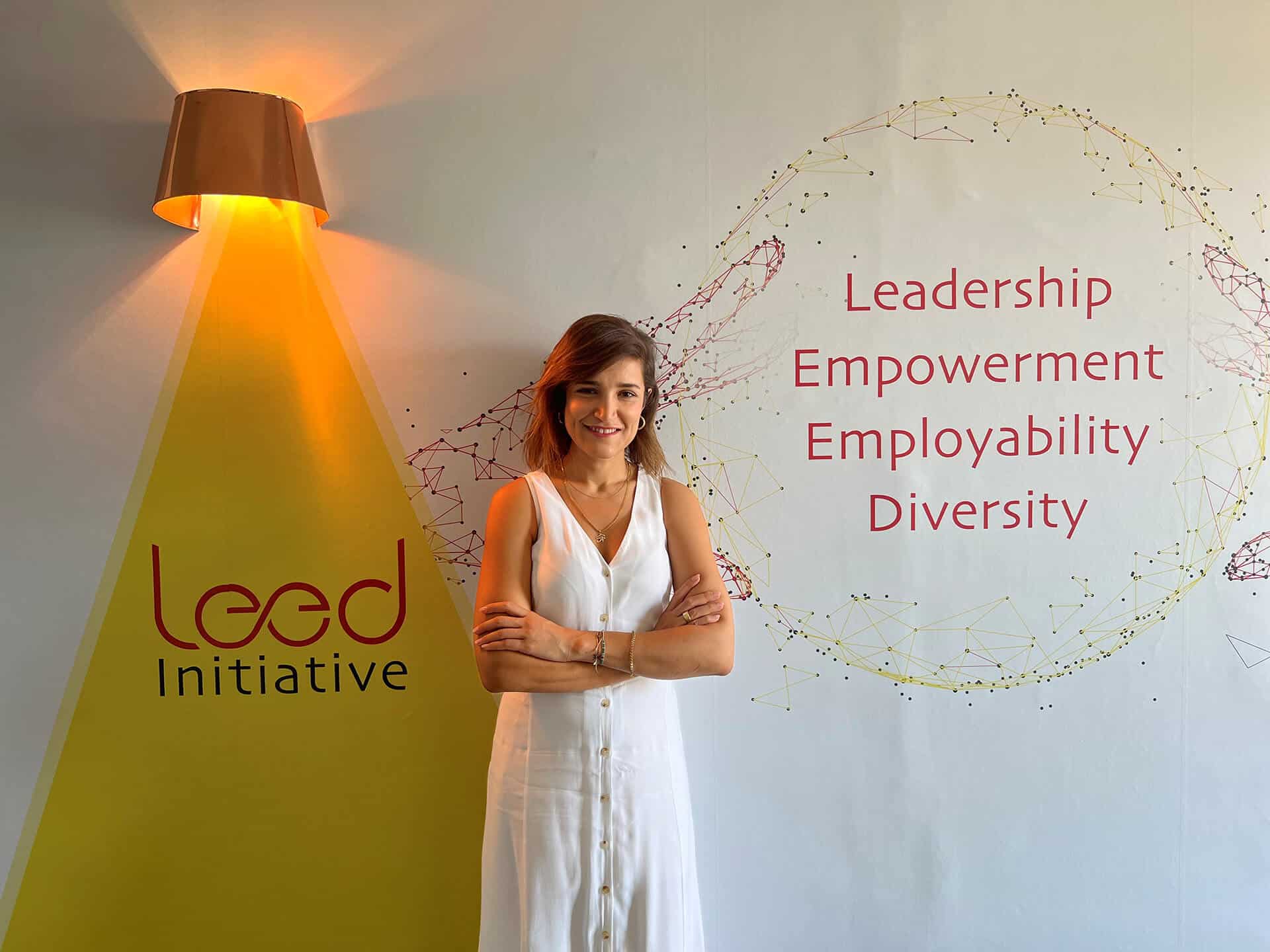
I would like to clarify first that LEED Initiative is an international organization that started its operations in the Middle East and North Africa, while its geographic scope extends to Europe, Sub-Saharan Africa and Central Asia. While launching LEED Initiative Joerg Schaeffer and I, wanted to engage at a first stage in the MENA as here exists the most pressing issues when it comes to women’s rights, youth and vulnerable groups’ empowerment. In my view, the biggest challenges in our region today are economic crises, over state indebtments, and political unrest in countries such as Libya, Lebanon, Sudan, Iraq and Tunisia, which consequently leads to putting issues such as gender fluidity, gender parity, gender-based violence as least concerns for our nations with varying degrees from one country to another depending on social contracts in each and the strength of human rights movements in general and feminist ones more specifically.
How can we concretely increase the participation of women and girls in the labor market, the economy, politics and social life in order to enable them to be more effective through greater visibility?
In my view, there are factors that we can act upon quickly to increase women’s and girls’ participation in the fields you have mentioned; and others that will require long term policy reform and implementation time. What we can act on rapidly are flexible working-time arrangements in the sense that policies that promote removing distortions against part-time work will boost female participation. Another one, is to give support to families with young children in the form of childcare subsidies, which are also identified as raising female participation. Other policies that impact positively on female participation are: avoiding regulations that impede the growth of service sectors and promoting policies that enhance women access to capital and supporting advisory mechanisms to launch successful businesses. On the other hand, the factors that will require a long period investment are definitely cultural attitudes, female education and overall labor market conditions.
To what extent does the promotion of so-called “feminist grassroots movements”[1] play an important role for an all-encompassing social change?
Feminist grassroots movements are of utmost importance to bring about a fresh look to the feminist movement worldwide. These young voices most from fourth wave feminism are coming up with new forms of promoting gender parity and new opinions on conceptualizing gender and defining it that previous waves of feminism can learn from and adapt to in their advocacy work. Additionally, the lack of institutional structuring of grassroots movements provides them with greater opportunities for reorganizing and creativity in leading movements for social change.
Nowadays many conflicts are taking over the news (climate crisis, corona, inflation, wars etc.). To what extent can such realities slow down or even stop the progress made so far in terms of equality?
These economic, environmental and political issues and crises impact us of course equality to a large extent. The first consequence of them is that they withdraw the focus and attention of decision-makers from tackling gender issues as they become of least importance when such crises take place. I can give an example here for Sudan: When the Sudanese Military Coup happened in October 2021, even our feminist organizations and grassroots movements partners from Sudan at LEED had to shift their thematic scope from advocating for women’s rights to a more reactive actions by joining movements of popular resistance. Another serious consequence is the surge of violence against women. We have seen this phenomenon growing with the confinement during the pandemic for instance. Moreover, if we look today at the Russia-Ukraine War that erupted in February 2022, there is an estimation of 7.7 million people who have been internally displaced (IDPs) from their homes, of which 60% are women.
What possibilities are there for European feminists to support the MENA region in its emancipation process?
I really think that European and MENA feminists can learn from each other so much on different levels as their battles align many times and diverge other times given that the fight for gender equality aligns significantly with the value system and social contract of each country on its own. So, there is no size fits all for advocating for rights, breaking down stereotypes and defining the concepts related to gender equality. I would recommend that there should be more cross border dialogue between feminist movements to refresh each other’s minds of activism strategies without having a Eurocentric way of exchange.

One thing that MENA feminists can enlighten European feminists about is not to study or look at MENA feminism as “Arab feminism” as I have mentioned that diverse factors are at play in each MENA country and MENA feminists are not all Arabs. Furthermore, “State feminism” is a significant common phenomenon across the Region that allows for tapping into very interesting case studies for European feminists that they can learn from and help them to create novel models of organizing.
Dear Nosra, thank you very much for your helpful tips and interesting insight. Finally, I would like to ask you: What will happen for you and LEED in the coming years?
Thank you again for having me. I am positive about the future when it comes to women empowerment and gender parity regardless of the current wave of crises that we are living in as you have previously mentioned. Chaos cannot be a permanent state and order comes after it in different forms with new ways of occupying the private and public sphere. As LEED Initiative, we will carry on empowering and promoting female leaders worldwide as influencers for others especially in STEM, innovating when it comes to creating solutions for youth unemployment to limit illegal migration and expand our operations beyond the MENA and Europe.
Dear Nosra, thank you for being part of the Role Model interview series. Your work is important not only for today’s generation of people, especially women and girls, but also for all generations to come. We are happy that we could give our community such a valuable insight into your work.
[Grassroots feminism is a worldview and political practice rooted in the realities and interests of women, queer, trans, and non-binary people who have been harmed by the intersecting forces of patriarchy, white supremacy, and capitalism. Grassroots Feminism is explicitly and unwaveringly anti-partriarchal, anti-racist, anti-capitalist, and anti-imperialist. We believe in solidarity across identities and borders, and in the joy of collective struggle. We fight for a just transition to a feminist economy where every person has what they need to fully realize themselves while being in right relationship with the planet and each other. The liberation of womxn is bound to the liberation of all oppressed peoples. Source: GGJ Grassroots Feminism team.
About the author
Kinga Bartczak advises, coaches and writes on female empowerment, new work culture, organizational development, systemic coaching and personal branding. She is also the managing director of UnternehmerRebellen GmbH and publisher of the FemalExperts magazine .



