


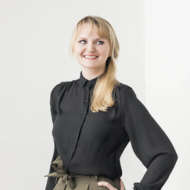
Jeannine Koch is executive chairwoman of medianet berlinbrandenburg e.V., multi-supervisory board member at VisitBerlin and Berlin Music Commission, founding member of the She means Community as well as member of the Digitalization Council Potsdam.
Dear Jeannine, I am very happy that you found the time to introduce yourself personally to our FemalExperts community.
I can imagine that many readers of our online magazine read your titles in awe and wonder what kind of personality lies behind all these responsibilities: Would you like to give us a little insight into your life so far?
I am a real Berlin plant and still belong to the internship generation. During my school and university years, I was able to gain various experiences in the different areas of the media world. During my studies, I first went on a world trip and then to Australia – I studied International Communications in Sydney and English/American Studies and Modern German Philology in Berlin. I graduated from the TU Berlin as a media consultant. I am also a trained systemic business coach. For six years, I was the marketing and communications director of the International Garden Exhibition, which attracted 2 million visitors* to Marzahn-Hellersdorf in Berlin in 2017 (IGA Berlin 2017), and then as director of republica GmbH – Europe’s largest digital and social conference – I was responsible for expansion and internationalization, among other things. Since January 2021, I have taken over the largest interdisciplinary industry network in the capital region, medianet berlinbrandenburg, with its almost 450 member companies – i.e. over 1,500 multipliers*.
As director of republica GmbH, you were previously responsible for numerous national and international conferences on social transformation and digitization. To what extent did this experience prepare you for your current responsibilities and challenges?
Even during my studies, I always worked in companies that had a strong focus on innovation, for example at Telekom at the time, where I was responsible for numerous digitization projects. In my final thesis at university, I looked at the impact of digitization on society. So I’ve been following these social changes for a long time and have always incorporated them into my areas of work, ways of working. This transformation through digitization has been taking place for several years now. Since the Corona pandemic, digital development in particular has once again accelerated enormously. But the international and multi-perspective approach of the re:publica with all its topics and innovations has definitely given me inspiration for my work at medianet. Even though we are a network for the Berlin-Brandenburg region, it is not enough to think in terms of borders. We live in a globalized world. So it’s always worth looking beyond the regional horizon – and we do that on an ongoing basis.
When I recall my experiences with the digital industry, I always saw a lot of women in marketing or social media. Do you think that a change has taken place here with regard to the digital industry and that we will now also see more women on (virtual/analog) stages in the area of new (digital) innovations?
At least I hope so. But I also see a clear trend toward more and more women taking on leadership positions in the digital industry. We have always had very diverse panels at our events, and there are exciting female personalities on them.
There are also signals from the political arena that women in business are generally receiving more support: The Senate Economic Administration recently launched the “Opportunity Fund” support program, which is intended to increase the proportion of self-employed women/women who start up their own businesses. That’s about networking events, coaching programs and advisory structures. I am convinced that our business location can only become stronger if it is characterized by diversity and female role models emerge from it.
We also support your exciting FEMALE INVESTORS’ DINNER with FemalExperts, a matchmaking dinner format that brings together early-stage startups from the B2B and B2C sectors with investors. You very often hear the criticism (not only in the digital industry) that female founders, for example, lack not competence but monetary resources. What is your assessment in this regard? Would you say with more capital, we also enable more (female) startup stories?
It’s ironic: statistics show that female founding teams generate an average of 10% more revenue and create about five more jobs than “male founder startups.” So there is certainly no lack of competence. The “Opportunity Fund” just mentioned, moreover, is intended to give women easier access to capital.
I see more social challenges here, because the image of women is still shaped by questions like: How long do you fall out of work because of pregnancy? Who looks after the children? As a result, there is less investment in female startup teams, studies show. I would like to see more women gaining a foothold in the startup scene through educational work and inspiring them with their creative ideas.
Do you have a specific tip for (aspiring) female founders in the digital economy that you perhaps wish you had received (earlier) yourself?
With a good idea, you rarely make it alone. I think it’s important to network early and have people around you who can give you competent and honest feedback. It is also indispensable to simply talk about the idea. In the past, it was often said: Don’t communicate the idea anywhere publicly, someone could come along and implement it before you do, that’s nonsense. It’s important to partner with the right people. Get advice and support, see if there is a special grant somewhere for the project, to get started and then the most important thing is to start and not be deterred! There will always be moments when you have the feeling that you’re at a standstill, that you’re not getting anywhere, that doors are still closed – then you have to look for an alternative path and keep going. And my personal advice in all endeavors is: Kill Your Darlings! Means: Focus on the essentials of your idea and try to leave out everything else – at least in the first step – or push it to the back, so you don’t get bogged down.
I was absolutely thrilled to read that you are also passionate about Diversity & Inclusion, People & Culture, Sustainability, and Women Leaders. I resonate with you in every respect here, as I too am strongly committed to this and our magazine naturally also wants to make these issues tangible and visible. What opportunities are there here to devote ourselves more intensively to these topics on a personal, economic and political level?
We have seen an incredible paradigm shift in recent years. I still introduced myself above as “Generation Internship”. I think all those who belong understand exactly what I mean by that. A lot of (in part really great, exciting) work, but no pay. In the past, the employer determined the market and created the rules, but for some time now, of course due to another paradigm shift, namely away from the age of industrialization to the age of digitalization, unprecedented job profiles have been sprouting from the ground, for some of which there are not even proper apprenticeships.

In addition, we are under the sword of Damocles of “demographic change”! By 2035, we will have a shortage of 7.2 million workers in Germany. These are huge social challenges. All of this together has led to the fact that we are now in an employee market. However, the employees of today and tomorrow now have very different ideas about how they want to shape their lives than the generations before them. As a result, we all have to take a hard look at ourselves, set up and run our companies differently, and simply accept that a new era has begun. This concerns the whole of society, every type and size of company. SPOILER: That won’t go away anytime soon either!
Now I know from my own experience that you don’t only get encouragement when you deal with cultural, inclusive, diverse or female empowerment issues. Have you ever experienced criticism here and if so, how do you find dealing with critical voices here?
Yes, there have certainly been and still are voices here in various places that question whether this is really necessary and whether the issues have not long since arisen of their own accord. I belong to a marginalized group myself, so to speak: “East German woman in a leadership position” – that is still a rarity in Germany. But I think that’s why all these topics are so close to my heart. As a person, I can authentically stand for equal opportunities and equal rights, and not only in terms of the distribution of women and men in positions of power. Diversity has so many facets and we all have to take them into account and think about them; people in the public eye in particular have a great responsibility here and I take that seriously.
Finally, I would like to ask you: What new missions await you as Chairman of the Board and CEO of medianet berlinbrandenburg e.V.? Where would you like to develop personally and entrepreneurially as a business leader?
I took over medianet in the midst of the biggest global crisis ever. Taking over a network in the middle of the pandemic, whose previous main task was to connect people through various event formats, with over 1,500 individuals, was sheer madness to say the least. However, I used this initial period two and a half years ago to set the course for the time after the pandemic. No one could have guessed that further serious crises would follow. Nevertheless, it is my goal to bring the unique selling point of the network, namely interdisciplinarity, even more into focus. Since the pandemic at the latest, most people and entrepreneurs have understood how important it is to interlink different sectors. It is the source of innovation and this is a real added value for medianet and our members. Connecting the different industries we represent, film/TV, media, creative agencies, startups and especially games, as one of the biggest growth markets, more strongly with each other, that will continue to be exciting.
We will be 22 years old this year, of course we want to keep growing. We also want the PEOPLE & CULTURE FESTIVAL to take place again in November. At the first edition, exciting companies from our media, creative and digital industries met potential new workers and learned about the latest trends in the world of work and training. I myself am a passionate idea and impulse generator and have a great interest in developing and driving innovative concepts for sustainable growth processes.
What an inspiring insight into the digital economy, thank you so much for this dear Jeannine. We hope to learn more about your personal and entrepreneurial life journey in the future and are already looking forward to the next events and exchange opportunities!
About the author
Kinga Bartczak advises, coaches and writes on female empowerment, new work culture, organizational development, systemic coaching and personal branding. She is also the managing director of UnternehmerRebellen GmbH and publisher of the FemalExperts magazine .



